Temperature
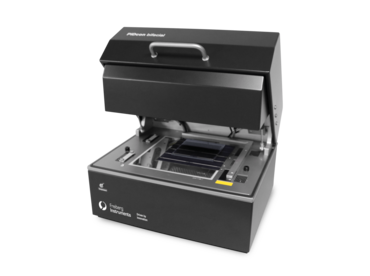
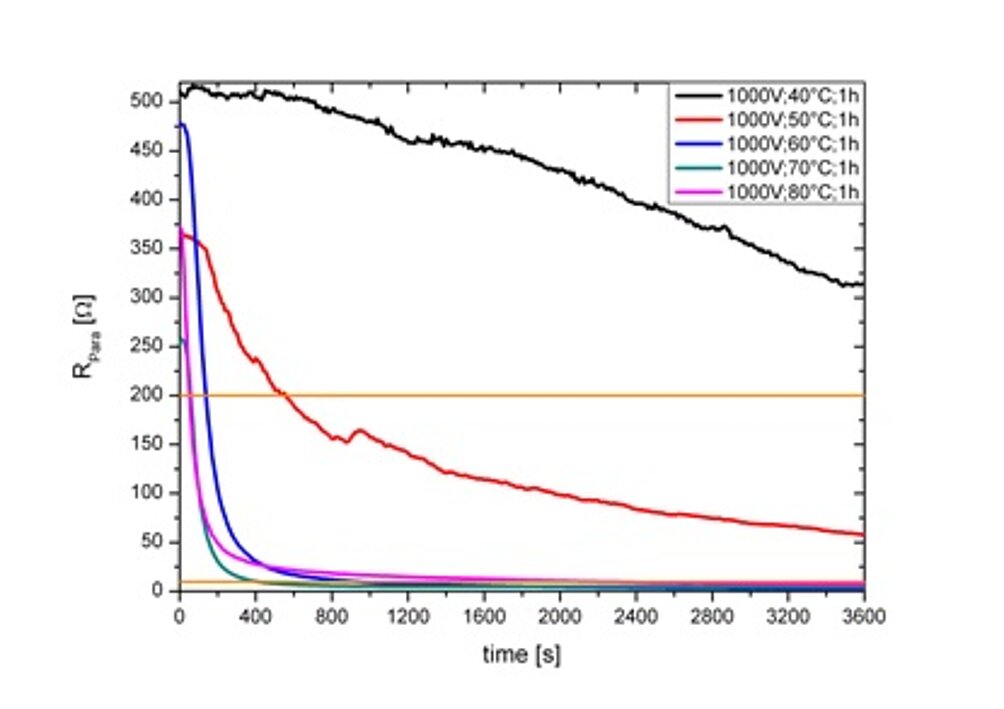
Higher heating plate temperatures lead to faster degradation of the solar cells. Unfortunately by using temperatures above 60 °C the EVA foil will irreparable damage the solar cell by conglutination. On the other hand simulates this lamination the situation of the module best.
Voltage
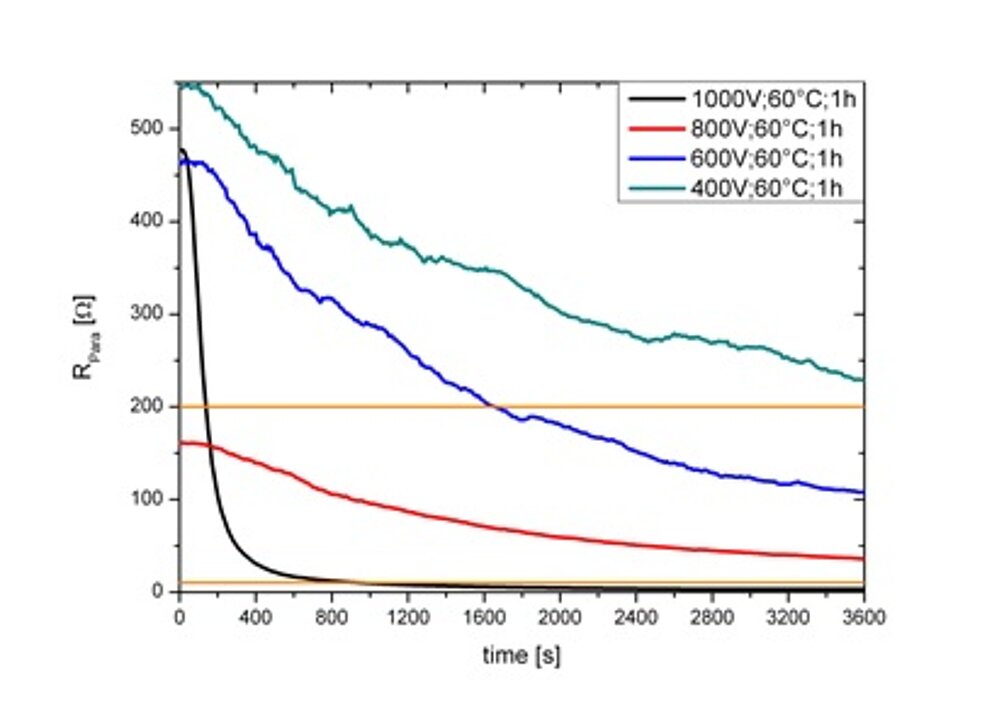
Usage of higher voltage is fastening the cell’s degradation. For fast degradation 1000 V are suggested, with 600 V differences between the cells are more finely graduated. It should be mentioned, that the voltage always is negative, so the PIDcon system is used for p-type cells.
Humidity
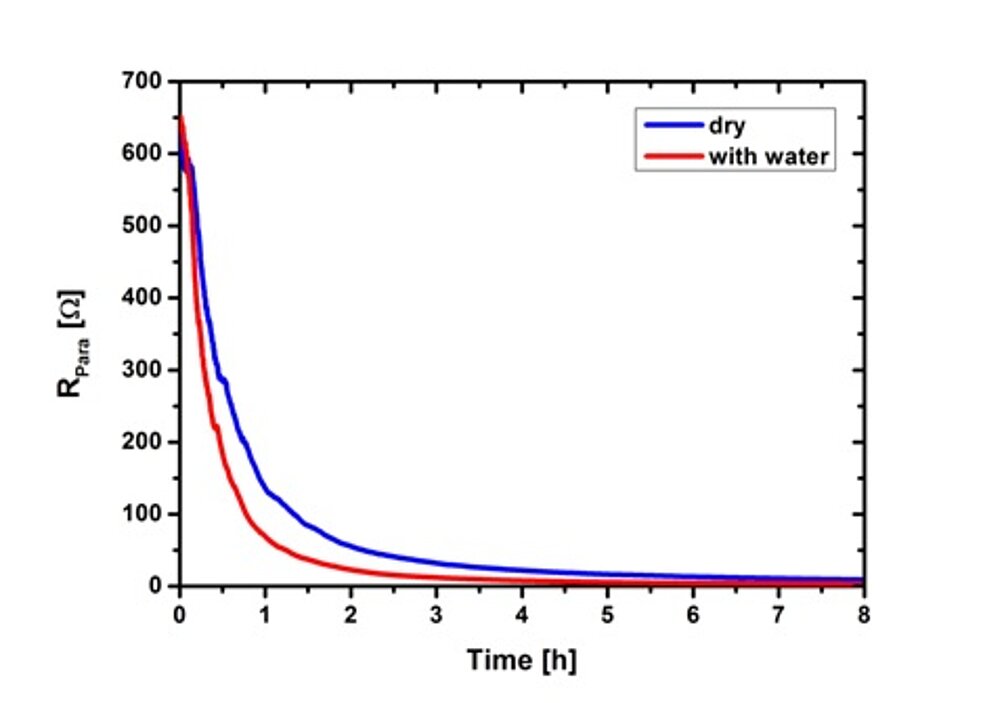
The influence of the humidity on the degradation result is insignificant, since the glass and EVA are press onto the solar cell and a full area contact is ensured. But if the cell is PID-resistant, small changes of humidity may result in small observable changes in the measured parallel resistance, since the contact resistance between the gold pins and the solar cell changes.
Light
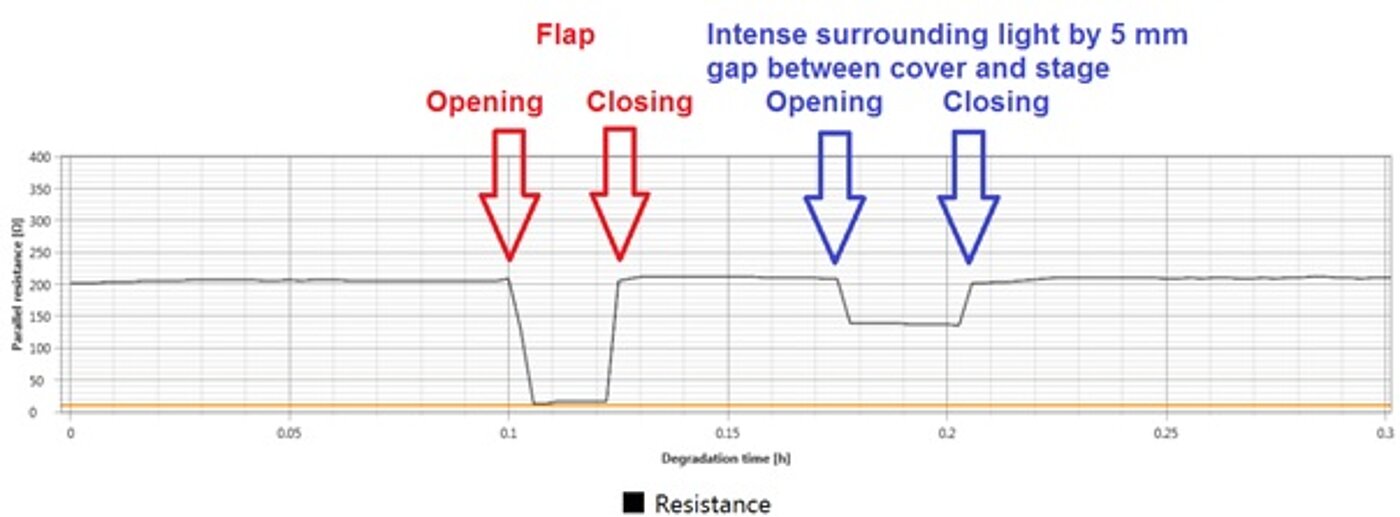
Light has a huge impact on the PID measurement. It has to be ensured that the flap and the cover are closed during the measurement.Furthermore the positioning of strong light sources around the PIDcon device should be avoided.
The diagram shows the influence on the resistance curve. For the first case the flap of the device was opened and closed, for the second one the cover was lifted to get a 5 mm gap to the ground plate and a strong illumination lamp was placed before the system and switched on and off.
Glass and EVA
From literature it is known that modules with quartz glas or alkali poor glas are not sensitive to PID-s. As shown in figure 1 also borat glas is well suited for modules which are stable against PID-s. Not necessary the Na concentration, but the resistivity of the glass from side to side is key for the PID susceptibility.
Different encapsulation foils seem to be well suited for PID-s resistant modules(e.g. polyvinylbutyral (PVB), Thermoplastic silicon-elastomer (TPSE), Polyethylene (PE)). Similar to the glass a high resistivity of the polymer foil seems to lead to a PID resistant behavior.
For more information please read:
[1] V. Naumann, Ursachenanalyse und physikalische Modellbildung für potenzial-induzierte Degradation von Silizium-Solarzellen, Dissertation, Martin-Luther-Universität Halle-Wittenberg (2014)