Found 271 results in 1 milliseconds.

Application

Solar Cell Classification

Solar Cell Classification The PIDcon enables quick, routine quality control of solar cell PID susceptibility, unaffected by the EVA foil and glass Potential Induced Degradation (PID) poses a significant reliability issue in PV power plants, making it essential to assess products for their susceptibility to PID. The PIDcon system enables manufacturers to test their products as early as possible in the production process, starting at the solar cell level, and to evaluate the encapsulation materials as well. This allows for independent investigation of the solar cell and its SiNx layer, separate from the effects of the EVA and glass. The type of PID considered here involves shunting of solar cells due to high-voltage stress-induced leakage currents (PID-s). To effectively classify solar cells, it is crucial to use sensitive EVA and glass materials so that the solar cell itself becomes the critical factor influencing the PID susceptibility of the entire stack. A lamination step can be added prior to measurement to enhance comparability with actual modules. The solar cells are connected using gold contact pins, which can be adjusted to fit the busbar design, even for island busbars. The PIDStudio software allows users to set pass/fail criteria for the test, suggesting defaults based on IEC standards and insights from Fraunhofer CSP scientists. Fig. 1: Solar cell with EVA foil and glass placed in a PIDcon Matching Products PID series PIDcon bifacial Quality Control Solution for Bifacial PERC/PERC+, HIT, Topcon, c-Si Solar Cells, Mini Modules, and More Learn more Get in touch Do not hesitate to contact us – we are available to assist you with any inquiries or requests. Use our inquiry tool or reach out via email: sales @ freiberginstruments.com

Application

EVA Evaluation

EVA Evaluation PIDcon allows producers to test both solar cells and encapsulation materials, with a focus on EVA foil’s impact on PID susceptibility The PIDcon allows for the investigation of how EVA foil affects PID susceptibility using a sample stack that simulates a module. To perform the test, the user simply places a solar cell, the EVA foil to be tested, and a glass layer on top. For accurate comparison, solar cells from the same batch and the same type of glass should be used. As shown in Figure 1, a noticeable difference in PID susceptibility is observed between the two EVA foils. EVA 1 demonstrates significantly better performance for modules than EVA 2. Fig. 1: comparison of different EVA foils with solar cells from the same batch and the same glass Fig. 2: measurement setup of a PIDcon Matching Products PID series PIDcon bifacial Quality Control Solution for Bifacial PERC/PERC+, HIT, Topcon, c-Si Solar Cells, Mini Modules, and More Learn more Get in touch Do not hesitate to contact us – we are available to assist you with any inquiries or requests. Use our inquiry tool or reach out via email: sales @ freiberginstruments.com

Application

Production Monitoring

Production Monitoring according to IEC 62804 standard Potential Induced Degradation (PID) is a significant reliability issue in photovoltaic (PV) power plants. It is crucial to assess the susceptibility of products to PID early in the production process. The PIDcon system is designed to help manufacturers test their products and evaluate encapsulation materials at the earliest possible stage in the production chain. PIDcon enables routine quality control for standard production cells, testing of new processes, material or layer variations, and qualification for various module production steps. The PID being referred to here involves shunting of solar cells caused by high-voltage stress-induced leakage currents (PID-s). The PIDcon's construction is nearly identical to the IEC standard (see figure 1). The sample stack, consisting of a solar cell, EVA foil, and glass, simulates a solar module. This method allows for the testing of both solar cells and encapsulation materials. Figure 2 illustrates a typical PIDcon measurement of a PID-sensitive solar cell. Key Advantages of PIDcon Over Conventional Module Testing No Climate Chamber Needed Early Measurement in the Production Chain Suitable for Both Research and Routine Production Quality Control Short Testing Duration (typically 4 to 8 hours) Measurement and Recording of Shunt Resistance with Estimation of Power Loss Fig. 1: measurement setup of a PIDcon Fig. 2: typical result of a PIDcon measurement Matching Products PID series PIDcon bifacial Quality Control Solution for Bifacial PERC/PERC+, HIT, Topcon, c-Si Solar Cells, Mini Modules, and More Learn more Get in touch Do not hesitate to contact us – we are available to assist you with any inquiries or requests. Use our inquiry tool or reach out via email: sales @ freiberginstruments.com

Product

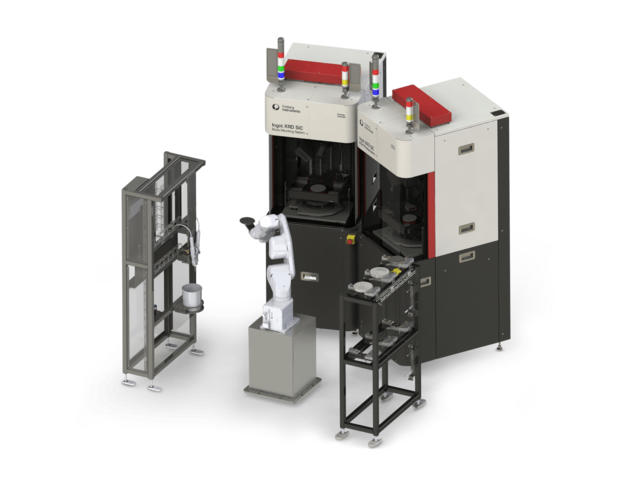
Ingot XRD SiC

Skip breadcrumb navigation Breadcrumb Freiberg Instruments Products X-ray Diffraction Ingot XRD SiC Ingot XRD SiC Enables existing equipment to reach high-end OD/Notch specs. Interested? Get in touch! Contact now Skip menu Quick navigation Features Technology Software Contact Revolutionize your ingot post glueing preparation: Automated, precise and modular Ultra-fast hybrid X-ray optical metrology with proprietary algorithm Robot driven operations with modular metrology and tooling Advanced factory connectivity and service provisions Materials The Ingot XRD SiC delivers high-throughput and precision for the efficient production of advanced SiC wafers. SiC GaN AIN and more Features & Benefits Unmatched Quality with hybrid metrology 0.005˚ On-axis precision Flexible Loading and communication options Diameter 100–300 mm Diameter 100–300 mm Interested? Our experts are happy to assist you. Get in touch! Contact us now! Technologies Omega-scan Ultra-Fast Orientation Measurement for Single Crystals Learn more Software XRDStudio Multiple Operating ModesOperator Mode: Designed for fixed measurement parameters, ensuring a safe and streamlined workflow. Administrator Mode: Allows for the creation and modification of… Learn more Get in touch Do not hesitate to contact us – we are available to assist you with any inquiries or requests. Use our inquiry tool or reach out via email: sales @ freiberginstruments.com

Industry

Research and Development

Research and Development Versatile Measurement solutions to empower and accelerate your R&D progress As a spin-off of the technical university in Freiberg, Freiberg Instruments has a strong scientific background and never stopped cooperating with scientific partners in a variety of research projects to develop measurement tools for the scientific community. Our tools come with a lot of options and accessories to offer tailored solutions to your research needs. Freiberg Instruments even offers customized solutions to ensure top notch research work. Discover R&D Projects Key Advantages Determine exact defect properties Enable temperature dependent measurements in a wide range of temperatures to determine the activation energy of defects High Accuracy and reproducibility High repeatability and reproducibility of all our products as well as reference samples and certificates ensuring traceable to highest standards High measurement speed and sensitivity Unsurpassed sensitivity and measurement speed for crystal orientation as well as lifetime measurements Versatile tools for ingots, wafers and even thin films We offer tools for all kinds of different sample geometries from large ingots (up to 850 mm length) to thin films (1 µm thickness and less) Temperature dependent measurements In order to investigate defects in semiconductors temperature dependent methods are an ideal method to determine activation energies. Usually for these methods it is necessary to form contacts on the samples, which can be very complicated and often alter the samples due to annealing steps. MDpicts is a non-destructive, contactless method with which the activation energies and capture cross sections of defects can be determined with a high accuracy. Investigation of surface and bulk quality The separation of bulk and surface quality is one of the main challenges of lifetime measurements. Freiberg Instruments offers a variety of different wavelength with different penetration depth and pulse length as well as estimations for bulk lifetime. Our Innovative Solutions XRD series Explore more DDCOM Learn more SDCOM Learn more MDP series Explore more MDPmap Learn more MDpicts pro Learn more MDpicts Learn more MDPspot Learn more HTpicts Learn more SPS/SPV series Explore more HR-SPSmap with fixed energy excitation sources Learn more HR-SPSmap with variable energy excitation source Learn more DPM series Explore more DPM100 Learn more Our Partners Get in touch Do not hesitate to contact us – we are available to assist you with any inquiries or requests. Use our inquiry tool or reach out via email: sales @ freiberginstruments.com Discover More Solutions Crystal Growth and Processing Learn more Epitaxial Layers & Thin Films Learn more Photovoltaic Learn more Luminescence Dating and Dosimetry Learn more

Industry

Radiation Monitoring

Radiation Monitoring System Cutting-Edge Technology for Accurate Radiation Detection and Measurement We are dedicated to delivering state-of-the-art radiation monitoring systems that cater to the varied requirements of industries necessitating precise radiation detection and measurement. Our extensive product portfolio, including devices like the SmartKONT contamination monitor and the SmartRAY2 high-range dose rate meter, ensures safety and regulatory compliance across a multitude of applications. By integrating advanced technology with user-centric design, we provide reliable solutions that uphold the highest standards of performance and accuracy. Key Advantages High Sensitivity and Accuracy Devices like the SmartKONT contamination monitor are designed to detect minimal levels of radiation, providing precise measurements essential for safety and compliance. Robust and Versatile Design Instruments such as the SmartRAY2 high range dose rate meter feature durable stainless steel housings, enabling reliable performance in various environments, including underwater applications up to 40 meters deep. Comprehensive Monitoring Solutions The Beta-Aerosol monitor offers continuous assessment of beta-emitting aerosols, ensuring real-time detection of airborne radioactive particles, which is crucial for maintaining air quality and safety in controlled environments. Real-Time Monitoring and Fast Response Many of Freiberg Instruments' radiation monitoring systems, such as the GM 2100 Gamma Radiation Monitor, feature real-time detection with visual and audio alarms. This ensures immediate response to radiation hazards, enhancing workplace and environmental safety. RMS series explore more RMS series SmartKONT Learn more RMS series Comet2500 Learn more RMS series SmartRAY2 Learn more RMS series Beta-Aerosol monitor Learn more RMS series GM 2100 Learn more Get in touch Do not hesitate to contact us – we are available to assist you with any inquiries or requests. Use our inquiry tool or reach out via email: sales @ freiberginstruments.com Discover More Solutions Crystal Growth and Processing Learn more Photovoltaic Learn more Luminescence Dating and Dosimetry Learn more Research and Development Learn more

Product

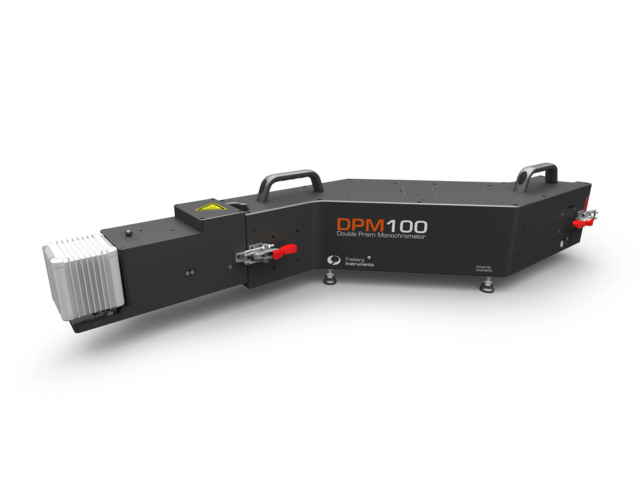
DPM100

Skip breadcrumb navigation Breadcrumb Freiberg Instruments Products Double Prism Monochromator DPM100 DPM100 Wide range double prism monochromator Interested? Get in touch! Contact now Product Sheet Skip menu Quick navigation Features Technology Contact Enables the adjustment of the wavelength over a wide spectral range without any discontinuities Extremely wide spectral range (0.4–7.3 eV/ 170 - 3100 nm) Spectral resolution: 2 meV – 100 meV (depending on wavelength and slit width) Excellent stray light suppression Materials The DPM100 can be used for all kinds of materials Si SiC Ge GaAs Ga₂O₃ InP Diamond and more Features & Benefits 0.4–7.3 eV Spectral range >10⁸ Stray light suppression 3 mm Spot diameter 2–100 meV Spectral resolution 2–100 meV Spectral resolution Interested? Our experts are happy to assist you. Get in touch! Contact us now! Technologies Electrical and optical characterization using surface photovoltage spe Photocarrier generation and separation mechanisms, Minority carrier lifetime measurement/Diffusion length calculations, Trapped carrier dynamics, time resolved, Surface Photovoltage… Learn more SPV signal analysis: fits and simulations We are currently developing simulation tools to enable first principle calculations of the electronic structure in a given photoactive material or material combination, based on solid-state… Learn more Comparison between MPD and SPV techniques MDP (microwave detected photoconductivity): sensitive to moving photogenerated charge carriers (bulk property), SPV (surface photovoltage): sensitive to surface AND bulk properties with respect… Learn more Static, transient or modulated light excitation pro and con The time-resolved or frequency-modulated, surface photovoltage spectroscopy (SPS) is based on a time-resolved/frequency modulated measurement of the spectral dependence of the surface… Learn more SPV-Picts SPV temperature dependence measurements Use this option to make SPV measurements at different temperatures between room temperature and 200°C. Temperature-dependent SPV measurements can be applied to measure activation energies or to… Learn more Materials Any photoactive material from raw material to finished device:From powder-based samples over wafers to boules or ingots. From 10 x 10 mm2 and up to 300 mm diameter, From titanium dioxide over… Learn more Get in touch Do not hesitate to contact us – we are available to assist you with any inquiries or requests. Use our inquiry tool or reach out via email: sales @ freiberginstruments.com

Page

Search

Search

Technology

XRDStudio

XRDStudio Cutting-Edge Software for Controlling X-ray Diffractometers User-Friendly and Advanced Operating Software Multiple Operating Modes Operator Mode : Designed for fixed measurement parameters, ensuring a safe and streamlined workflow. Administrator Mode : Allows for the creation and modification of measurement recipes, as well as adjustments for new materials. Intuitive Guided Interface Ensures a seamless and efficient workflow for users of all experience levels. Pre-Defined and Customizable Recipes Choose from a range of ready-made recipes or create custom ones to suit specific needs. Automatic Display of Results and Correction Values Instant visualization of measurement results along with automatic correction values to fine-tune crystal orientation. Mapping Capabilities Advanced mapping features for precise measurement analysis. Import/Export Functions Effortlessly import and export data for easy sharing and integration with other systems. Get in touch Do not hesitate to contact us – we are available to assist you with any inquiries or requests. Use our inquiry tool or reach out via email: sales @ freiberginstruments.com

Product

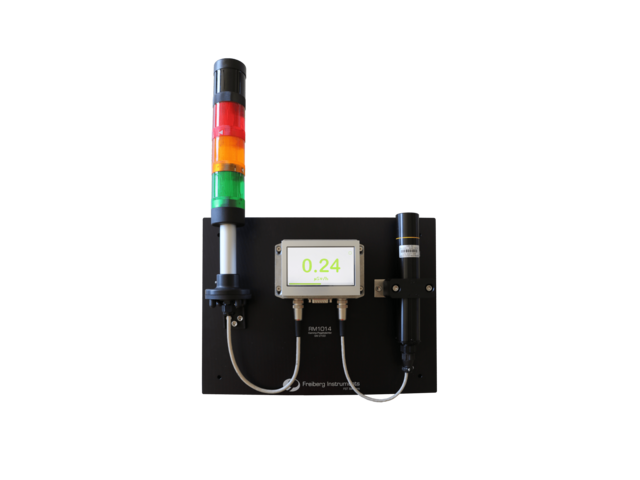
GM 2100

Skip breadcrumb navigation Breadcrumb Freiberg Instruments Products Radiation Monitoring Systems GM 2100 GM 2100 Gamma Radiation Monitor Interested? Get in touch! Contact now Skip menu Quick navigation Features Contact Features & Benefits Compact design Wall mounted Audio and visual alarms Plug and play Detector low range gamma radiation detector internal calibration factor splash proof aluminium housing measuring range: 0.1 μSv/h to 10 mSv/h accuracy: ±10% reading within the measuring range Electronics 4“ TFT touchscreen with a resolution of 480 x 272 pixels adjustable alarm limits local signalization of alarms via. light tower with buzzer potential-free relay contacts for external signalization Get in touch Do not hesitate to contact us – we are available to assist you with any inquiries or requests. Use our inquiry tool or reach out via email: sales @ freiberginstruments.com