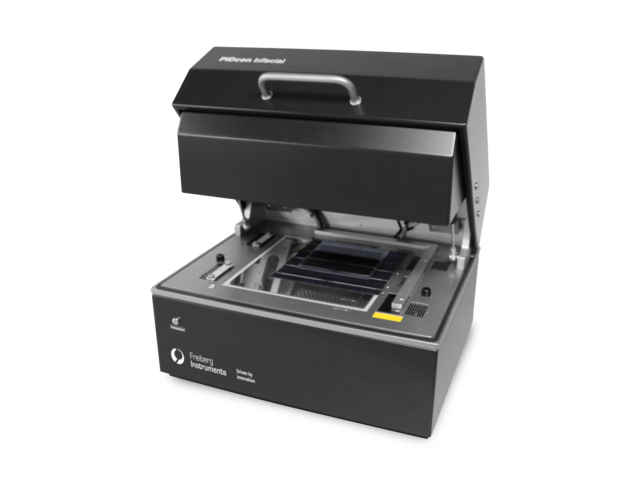
Skip breadcrumb navigation Breadcrumb Freiberg Instruments Products Potential Induced Degradation PIDcon bifacial PID con bifacial Quality Control Solution for Bifacial PERC/PERC+, HIT, Topcon, c-Si Solar Cells, Mini Modules, and More Interested? Get in touch! Contact now Product Sheet Skip menu Quick navigation Features Applications Specifications Technology Contact Benchtop PID tester for c-Si solar cells and mini-modules PID detection at cell level Research, Production & Quality Control of PERC, AL-BSF, PERC+, bifacial PERC, PERT, PERL and IBC solar cells No climate chamber necessary Features & Benefits Measurements of cells Test duration: 4 hours (typical) Voltage: ± 1.5 kV Module vs. Cell level PID test Applications Production Monitoring Potential Induced Degradation (PID) is a significant reliability issue in photovoltaic (PV) power plants. It is crucial to assess the susceptibility of products to PID early in the production… Learn more EVA Evaluation The PIDcon allows for the investigation of how EVA foil affects PID susceptibility using a sample stack that simulates a module. To perform the test, the user simply places a solar cell, the EVA… Learn more Solar Cell Classification Potential Induced Degradation (PID) poses a significant reliability issue in PV power plants, making it essential to assess products for their susceptibility to PID. The PIDcon system enables… Learn more Mini-module Classification Potential Induced Degradation (PID) is a critical reliability issue in PV power plants, making it essential to assess products for their susceptibility to PID. The PIDcon system helps… Learn more Glass Evaluation For more information please read:[1] V. Naumann, Ursachenanalyse und physikalische Modellbildung für potenzial-induzierte Degradation von Silizium-Solarzellen, Dissertation,… Learn more With our PIDcon bifacial testing device, module manufacturers can perform reliable quick tests of solar cells and encapsulation materials during production. Dr. Christian Hagendorf Key Account Manager Interested? Our experts are happy to assist you. Get in touch! Contact us now! Specifications Type Stress Recovery PID-s front 85 °C, +1.5 kV 85 °C, -1.5 kV PID-p rear 85 °C, +1.5 kV, without illumination 85 °C, dark storage or illumination PID-c rear 85 °C, +1.5 kV, with illumination Not possible Lamination 150 °C, 20 min Sample size up to 210 x 210 mm Suitable for For PERC, AL-BSF, IBC, PERC+, bifacial PERC p- and n-type Measurement of Measurement of: R parallel , leakage current, IV curve under illumination Download Product Sheet PDF (640 KB) Technologies Physical Nature of PID-s In the field a large potential between the front glass surface and the solar cells in a module can occur and a shunting of the p-n junction of a Si solar cell and accordingly a decrease in… Learn more Comparison of PID Test Methods The PIDcon test has the following advantages compared to other methods:Short duration (usually 4–8h), High variability: test of solar cell, mini-module, glass and EVA, Good control of test… Learn more Dependencies of PID Susceptibility For more information please read:[1] V. Naumann, Ursachenanalyse und physikalische Modellbildung für potenzial-induzierte Degradation von Silizium-Solarzellen, Dissertation,… Learn more Conductance Test and Power Loss Furthermore an easy pass or fail criterion after finishing the PID measurement is suggested. It is assumed that an efficiency loss of 3% at the end of the PID test lead to a fail of the solar… Learn more Get in touch Do not hesitate to contact us – we are available to assist you with any inquiries or requests. Use our inquiry tool or reach out via email: sales @ freiberginstruments.com